Throughout the 12 weeks, I have made a detailed plan on what i want to achieve once the course is finalized. Originally I did want to go down the route of self employment but with the detailed run-down of freelance work I covered in the prior posts, I believe not only would this be too stressful, finding enough work to even build experience could be next to impossible. The most logical choice would be to find a game company locally and contact them in regards to work experience and if possible, a paid placement for the future. Simply having a large AAA developer's name on my portfolio and CV as a past employer would work wonders in getting a permanent job later down the line but financially, I see myself only having two options;
Either, I spend the next sixth months minimum working at a part time job, building my portfolio on the side or attempt to find a full-time job for the same time period to pool some money together. With 6-12 months stocked up, I will have enough to cover very basic accommodation, travel and food for a moderate amount of time. With this, I can then contact a more distant game company such as Sumo Digital and apply for work experience. If I took the full time job route, my abilities would remain roughly the same and I would have a larger financial safety net but if I had decided to take the part time rough, the extra 6 to 12 months progress would leave me in a much more employable state with less financial security, greatly improving my chances of solidifying myself as part of the team and possibly allowing me to receive paid employment. Alongside this, it would give me the time to develop a small following on social media, increase my linked-in presence and join modding communities to receive professional feedback on my work/ make useful contacts.
Second option; After graduation, I can source a local game company such as "Eight Pixel Square" http://www.eightpixelssquare.com/games and ask them about possible work placements as they seem to be the best positioned game company to my home in Milford, making it possible to work there to gain experience for a minimum of 3 months without many personal outgoings. With only a three month period, I cannot see it causing many issues financially and it would provide me with much needed experience/ discipline.
Realistically, I see the best option for me would be to take a few points from both. Straight off the bat, I will be looking at vehicle artist jobs in the UK for junior artists whilst developing my portfolio. As my show-reel will be focusing on only three vehicles at a time alongside their scene, I will need to re-texture the M4 Sherman tank, create it's scene as discussed prior and entirely make a asset using the skills I learn't from this project as the RC car is in dire need of replacement. If I haven't had very much look after a 3 month period, I will move very swiftly on to contacting local game companies for short term work experience placements. If no permanent placement is possible from this, I will turn my eye towards either a part-time or fulltime job to build up funds whilst I develop my skills in areas such as "Substance" "Zbrush" and "Quixel" as these are all the new base-line standards of most environmental and vehicle modelling jobs in the UK.
With this premise, I should be left with a back-up plan, always giving me a way forward to increase my ability, bring up my financial safety net and should never be left at a stand-still. Overall, I'm very much looking forward to this process and in the mean time, will be trying to take part in as many game art contests I can find. As well as improving my ability to work to a deadline, this will force me to gain experience in game engines such as Unity and Source SDK, depending on what company is sponsoring the contest. Many students that take part in these contests are offered job placements and usually develop great game industry contacts along the way.
As a final point, I will be posting all complete work on Twitter as i have now done with the I-ray renders of the Mad Max vehicle to build up my contacts as this has worked extremely well for other students and to stay in the blog mindset, will be creating full run-downs of any independent project on Poly Count forum.
Website wise, as im just handing in the design, I will be re-evaluating it based on marking feedback before transitioning to Weebly as this has turned out to be a fantastic website not only for blogs but makes the construction of a portfolio incredibly easy. I did have a decent website hosted on SquareSpace although the monthly £6.50 is far too damaging to my bank account and i would like to find either a cheaper alternative or a one time payment service in early january.
Friday, 11 December 2015

Wednesday, 9 December 2015
The Showreel
To create my showreel plan, I took every point I could from the prior studies and attempted to incorporate this in to a minute and a half. Focusing on three vehicles, I could spend 30 seconds on each one to avoid boring the viewer.
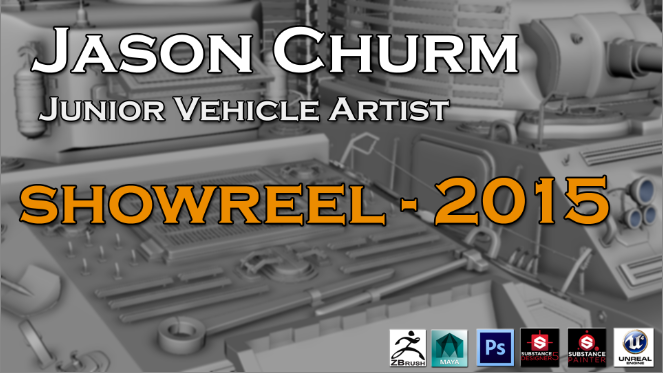
To start, I needed a splash screen. Originally this was going to be placed on an asset in my first matinee but this gave me too many limitations. As i said in the first few PPD posts, it would be great but only really works reliably for an environmental artist as I want the viewer fixated on the vehicle, not the supporting scene around it. So with all this considered, I created a minimalist intro, showing my name, the purpose of the video and icons for the software suites used, attempting to capture the colour and font choice from my website design.
The main font choices being "Copperplate Gothic Bold" for main headings and "verdana" for sub information. To add a little more mystery to this, I took the high poly tank model i created last year, organized a nice scene, took a 1080p screen grab and slightly blued it in Photoshop. I found from most of the showreels in my research that the background of the intro screen should not contain anything overwhelming that could distract the viewer from the text.
I feel like the blur has done quite nicely here. On top of this, I ensured that the software used included all those that would be required for a vehicle artist, bar Quixel as I don't want to give any impression that the texture work was automatically generated. These icons do appear on the website design throughout to ensure that all future software bases will be covered.
Originally, I hadn't included the Zbrush icon on the start and end splash screens as it wasn't technically used but by displaying it alongside the rest of the software packages, I can show a wide range of employable skills. On top of this, i added an inner bevel and large drop shadow behind each piece of text. This ended up looking rather tacky and was removed.
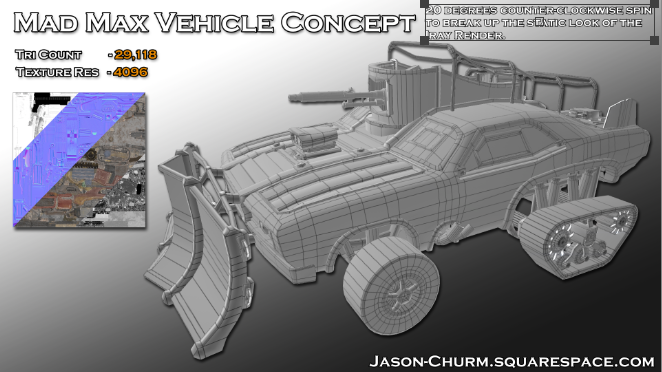
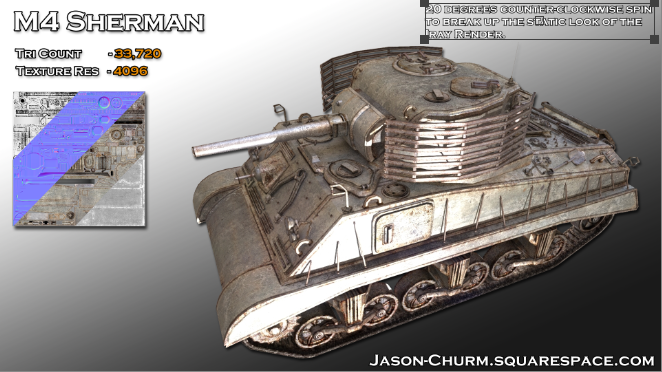
This could then transition using a side swipe to the vehicle showcase. For each of these assets, I created an asset template, displaying the vehicles name, tri count, texture resolution and a small cross section of the maps used. A portfolio link in the bottom right throughout to give a point of contact and room for a larger render of the vehicle in the center right. I rendered the vehicle out first as a wireframe before fading in to an exact copy of the slide but with an I-ray render instead. This allows me to slowly transition from one to the other without changing the point of focus. With all of these vehicle starting slides, I want to have the vehicles slowly rotating counter-clockwise by 20 degrees but being I-ray i couldn't find how to create anything more than screenshots. Either way, this slide shows all the information that a possible employer way wish to see when judging an artists work.
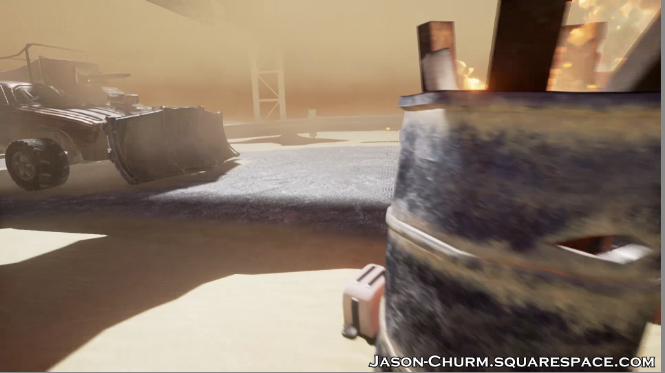
The slide then fades in to the A3D matinee renders, taking the rule of thirds and basic composition in to consideration, starting with the barrel asset to the right of the camera, vehicle to the left and sandstorm slowly moving in from the center. It ensures that there is always something to catch the user's eye, quickly transitioning from barrel to vehicle.
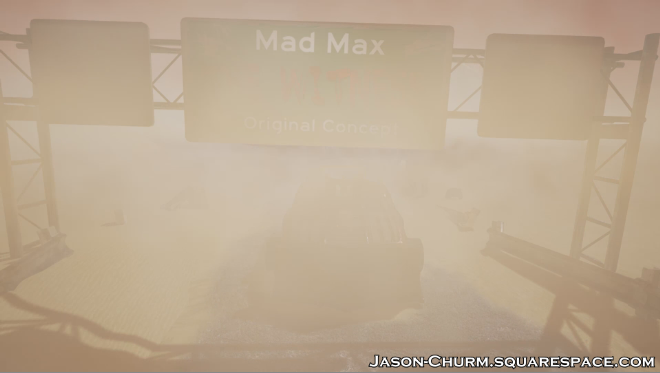
With each of these vehicle matinee renders, I tried to focus on four 5-10 second cameras, firstly showing a zoom in to the vehicle, before a side view which could then transition to any point of interest such as the MadMax gun before zooming outwards. Using simple fades between matinee cameras and having the sand-storm slowly roll in (as covered extensively in the A3D blog), I could have the sun and slighting slowly drop until the final outwards pan with sand slowly overtaking the camera view, making for a very nice and natural transition.
The same I-ray showcase and template was used for the tank to ensure the composition would stay the same and avoid confusing the viewer. I had been asked a few times why I didn't include a spin but I honestly didn't see it as being very ascetically pleasing although after talking to Jamie about the subject, he gave me a full run-down on what to add to the reel to make it employable. He told me the importance of simple May mesh turn-tables/ spins as a serious employer would not be all to interested in the post production and glamour, they would need to see evidence of modelling strength/ the geometry and both texturing/ UV'ing ability in greater detail. This will be factored in later iterations but will primarily be covered in the following blog post/ the final sign-off.
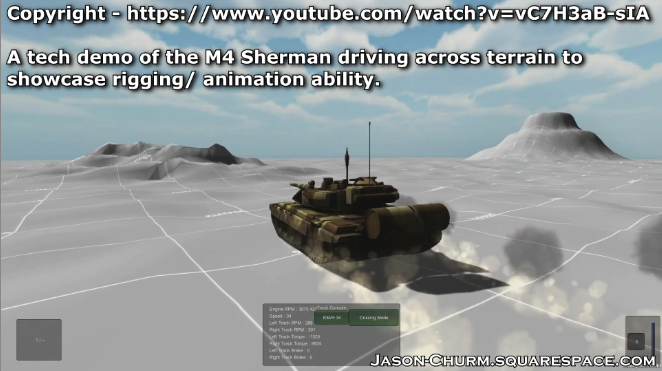
As this is simply a static asset with no animation, I placed it in a basic UE4 scene to set up the rough matinee sequence, following the same camera principles as the Mad Max vehicle but still wished to add some motion to this scene. To give a good understanding of how I wished to have it displayed, I found a tech-demo of an M$ Sherman driving across terrain, labeled this as a showcase for rigging/ animation ability and made certain to add the copyright link. Seeing this prior to the basic matinee sequence allows you to visualize the artistic vision even with the scene being static.
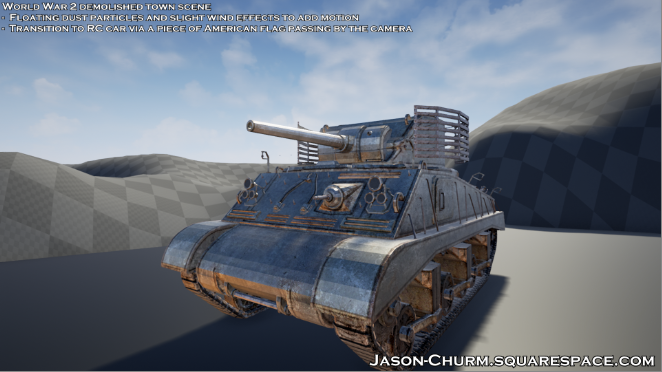
For the final two vehicles, I was unable to create an environment for them in time but managed to get around this by putting simple bullet-points in the top left corner to explain the scene and transition. To add motion to the scene, I wanted to add floating dust particles and slight wind effects. Transition wise, I wanted to leave the final camera pan with a piece of charred American flag passing the camera which could lead to a very nice transition to the final vehicle; the RC car.
I found that this methodology was mostly found in VFX showcases but when done right, turned the reel from an individual showcase to what could be interpreted as more of a short movie. Originally I did want to add basic motion blur to the background as the pans crossed both the tank and RC car models but this proved far too difficult with random areas of the vehicles bluring at random matinee points, only showing this broken effect when physically rendering out.
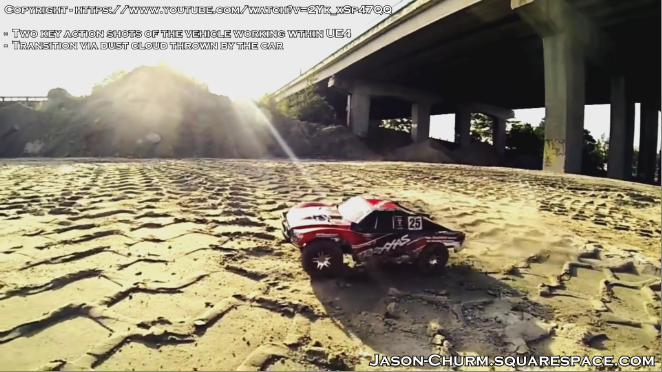
The exact same format from the tank was then used for the RC car with only minor variations. Instead of viewing the I-ray renders from the same front angle, they were taken from the rear as this is where the vast majority of the model details were located. Once again with the model being static, I found a great cinematic of RC cars driving through the sand that i would like to imitate. Focusing on two main shots of the RC cars drifting, the scenes have perfect competition with even areas such as the bridge and terrain following the path/ curve of the vehicle. The transition between them via dirt being kicked up from the drifts is also a fantastic idea that I hope to capture once I have time to animate the asset.
With the RC car being my weakest asset out of the lot, I reduced it from the four camera pan template down to three, starting with a zoom in of the bonnet, transitioning to a slow pan from front wheel to back and the final one, zooming out from the rear turbine. With it being such an awkward object to showcase, I attempted to follow the golden ratio with composition for the final outwards pan and tried to focus the camera work so the center focus point at the start of each pan was directly on the asset. A sweeping motion past the asset would work nicely if it had an environment to benefit it but in this case, I had far less to work with.
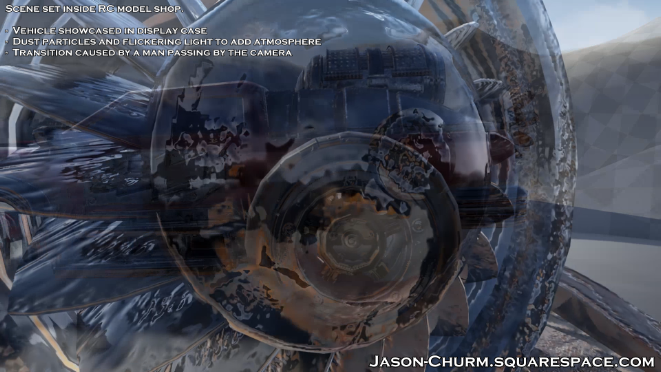
Direction wise, I wanted to have the vehicle transition from the realistic drifting animations to a display case in an RC model shop, zooming out to the silhouette of a child to imply the first animated scene was a figment of the child's imagination. With flickering lights and dust particles to add further atmosphere, the scene would transition via someone walking by the case, close enough to the camera to block it out, making full use of the footstep sounds as the character gets closer.
This would then function as a right to left side swipe transition, displaying the final splash screen, displaying all the starting information alongside contact details. As an added touch and to try and show the care put in to this, the background image has also been reversed to point in the same direction as the transition.
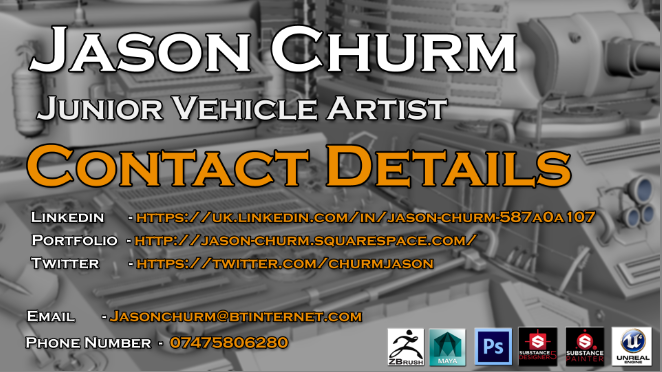
I found that most the the top tier show-reels tried to focus on their very specific colour scheme, usually white, black or grey with the addition of one colour to add some warmth to the spectrum.
Now the music choice. This was by far the hardest part of the show-reel creation as almost every established artist paid to have music composed specifically for their reel. To start with, I used quite a depressing silent hill remix as you'll see in the comparison below because even though it didn't turn out being the happiest music in the world, it fit each transition perfectly and was just earey enough to set the mad max vehicle and tank theme.
The major issue with this song is that it began to transition to a much darker theme at the 1 minute mark which made it very unfitting for the RC car. Even the ending transition worked perfectly, fading off to a simple percussion beat as the final slide presented itself. As well as it fit with transitions, its pacing seemed slightly off in comparison to the track "Siege Mentality" that I found as a replacement. All VFX and vehicle showreels i had reviewed prior used a soundtrack that would start slow and mysterious before moving towards a slightly faster paced, suspense style. This seems to work perfectly to capture the viewers attentions for the 1 minute 30 optimum video length. I simply wish I was able to find a song that captured the energy of "siege Mentality" but the timing of the Silent Hill remix track.
Overall, it left me with a perfectly usable backing track for the showreel that worked pretty nicely with the moderately fast paced camera transitions but for future iterations, I will attempt to commission the best of both worlds. Currently this is too expensive an option but should be entirely viable within the future,
First Iteration of the showreel;
Final Iteration of the showreel;
Overall, I have tried to incorporate the best features of each prior reviewed showreel and have managed to learn a lot from what didn't work, mainly the concept of having the vehicle information within the UE4 scene. When I have more experience/ time to create environments alongside the vehicle, this could be a great addition but was not possible to fully evaluate and test with the 12 week time requirement. I want to shy away from just doing the vehicles alone as creating a nice environment around them also opens up the possibility of environmental design which opens many more doors for a junior artist as proven by Danny Banister in the week 4 guest presentation.
He explained how within a large studio, you may need to be transitioned from vehicle to environment for some projects and having the knowledge available to do so will make you a much valuable employee, essentially giving you the ability to not only perform both rolls but also the knowledge to create environments and vehicle that compliment each other.
To start, I needed a splash screen. Originally this was going to be placed on an asset in my first matinee but this gave me too many limitations. As i said in the first few PPD posts, it would be great but only really works reliably for an environmental artist as I want the viewer fixated on the vehicle, not the supporting scene around it. So with all this considered, I created a minimalist intro, showing my name, the purpose of the video and icons for the software suites used, attempting to capture the colour and font choice from my website design.
The main font choices being "Copperplate Gothic Bold" for main headings and "verdana" for sub information. To add a little more mystery to this, I took the high poly tank model i created last year, organized a nice scene, took a 1080p screen grab and slightly blued it in Photoshop. I found from most of the showreels in my research that the background of the intro screen should not contain anything overwhelming that could distract the viewer from the text.
I feel like the blur has done quite nicely here. On top of this, I ensured that the software used included all those that would be required for a vehicle artist, bar Quixel as I don't want to give any impression that the texture work was automatically generated. These icons do appear on the website design throughout to ensure that all future software bases will be covered.
Originally, I hadn't included the Zbrush icon on the start and end splash screens as it wasn't technically used but by displaying it alongside the rest of the software packages, I can show a wide range of employable skills. On top of this, i added an inner bevel and large drop shadow behind each piece of text. This ended up looking rather tacky and was removed.
This could then transition using a side swipe to the vehicle showcase. For each of these assets, I created an asset template, displaying the vehicles name, tri count, texture resolution and a small cross section of the maps used. A portfolio link in the bottom right throughout to give a point of contact and room for a larger render of the vehicle in the center right. I rendered the vehicle out first as a wireframe before fading in to an exact copy of the slide but with an I-ray render instead. This allows me to slowly transition from one to the other without changing the point of focus. With all of these vehicle starting slides, I want to have the vehicles slowly rotating counter-clockwise by 20 degrees but being I-ray i couldn't find how to create anything more than screenshots. Either way, this slide shows all the information that a possible employer way wish to see when judging an artists work.
The slide then fades in to the A3D matinee renders, taking the rule of thirds and basic composition in to consideration, starting with the barrel asset to the right of the camera, vehicle to the left and sandstorm slowly moving in from the center. It ensures that there is always something to catch the user's eye, quickly transitioning from barrel to vehicle.
With each of these vehicle matinee renders, I tried to focus on four 5-10 second cameras, firstly showing a zoom in to the vehicle, before a side view which could then transition to any point of interest such as the MadMax gun before zooming outwards. Using simple fades between matinee cameras and having the sand-storm slowly roll in (as covered extensively in the A3D blog), I could have the sun and slighting slowly drop until the final outwards pan with sand slowly overtaking the camera view, making for a very nice and natural transition.
The same I-ray showcase and template was used for the tank to ensure the composition would stay the same and avoid confusing the viewer. I had been asked a few times why I didn't include a spin but I honestly didn't see it as being very ascetically pleasing although after talking to Jamie about the subject, he gave me a full run-down on what to add to the reel to make it employable. He told me the importance of simple May mesh turn-tables/ spins as a serious employer would not be all to interested in the post production and glamour, they would need to see evidence of modelling strength/ the geometry and both texturing/ UV'ing ability in greater detail. This will be factored in later iterations but will primarily be covered in the following blog post/ the final sign-off.
As this is simply a static asset with no animation, I placed it in a basic UE4 scene to set up the rough matinee sequence, following the same camera principles as the Mad Max vehicle but still wished to add some motion to this scene. To give a good understanding of how I wished to have it displayed, I found a tech-demo of an M$ Sherman driving across terrain, labeled this as a showcase for rigging/ animation ability and made certain to add the copyright link. Seeing this prior to the basic matinee sequence allows you to visualize the artistic vision even with the scene being static.
For the final two vehicles, I was unable to create an environment for them in time but managed to get around this by putting simple bullet-points in the top left corner to explain the scene and transition. To add motion to the scene, I wanted to add floating dust particles and slight wind effects. Transition wise, I wanted to leave the final camera pan with a piece of charred American flag passing the camera which could lead to a very nice transition to the final vehicle; the RC car.
I found that this methodology was mostly found in VFX showcases but when done right, turned the reel from an individual showcase to what could be interpreted as more of a short movie. Originally I did want to add basic motion blur to the background as the pans crossed both the tank and RC car models but this proved far too difficult with random areas of the vehicles bluring at random matinee points, only showing this broken effect when physically rendering out.
The exact same format from the tank was then used for the RC car with only minor variations. Instead of viewing the I-ray renders from the same front angle, they were taken from the rear as this is where the vast majority of the model details were located. Once again with the model being static, I found a great cinematic of RC cars driving through the sand that i would like to imitate. Focusing on two main shots of the RC cars drifting, the scenes have perfect competition with even areas such as the bridge and terrain following the path/ curve of the vehicle. The transition between them via dirt being kicked up from the drifts is also a fantastic idea that I hope to capture once I have time to animate the asset.
With the RC car being my weakest asset out of the lot, I reduced it from the four camera pan template down to three, starting with a zoom in of the bonnet, transitioning to a slow pan from front wheel to back and the final one, zooming out from the rear turbine. With it being such an awkward object to showcase, I attempted to follow the golden ratio with composition for the final outwards pan and tried to focus the camera work so the center focus point at the start of each pan was directly on the asset. A sweeping motion past the asset would work nicely if it had an environment to benefit it but in this case, I had far less to work with.
Direction wise, I wanted to have the vehicle transition from the realistic drifting animations to a display case in an RC model shop, zooming out to the silhouette of a child to imply the first animated scene was a figment of the child's imagination. With flickering lights and dust particles to add further atmosphere, the scene would transition via someone walking by the case, close enough to the camera to block it out, making full use of the footstep sounds as the character gets closer.
This would then function as a right to left side swipe transition, displaying the final splash screen, displaying all the starting information alongside contact details. As an added touch and to try and show the care put in to this, the background image has also been reversed to point in the same direction as the transition.
I found that most the the top tier show-reels tried to focus on their very specific colour scheme, usually white, black or grey with the addition of one colour to add some warmth to the spectrum.
Now the music choice. This was by far the hardest part of the show-reel creation as almost every established artist paid to have music composed specifically for their reel. To start with, I used quite a depressing silent hill remix as you'll see in the comparison below because even though it didn't turn out being the happiest music in the world, it fit each transition perfectly and was just earey enough to set the mad max vehicle and tank theme.
The major issue with this song is that it began to transition to a much darker theme at the 1 minute mark which made it very unfitting for the RC car. Even the ending transition worked perfectly, fading off to a simple percussion beat as the final slide presented itself. As well as it fit with transitions, its pacing seemed slightly off in comparison to the track "Siege Mentality" that I found as a replacement. All VFX and vehicle showreels i had reviewed prior used a soundtrack that would start slow and mysterious before moving towards a slightly faster paced, suspense style. This seems to work perfectly to capture the viewers attentions for the 1 minute 30 optimum video length. I simply wish I was able to find a song that captured the energy of "siege Mentality" but the timing of the Silent Hill remix track.
Overall, it left me with a perfectly usable backing track for the showreel that worked pretty nicely with the moderately fast paced camera transitions but for future iterations, I will attempt to commission the best of both worlds. Currently this is too expensive an option but should be entirely viable within the future,
First Iteration of the showreel;
Final Iteration of the showreel;
Overall, I have tried to incorporate the best features of each prior reviewed showreel and have managed to learn a lot from what didn't work, mainly the concept of having the vehicle information within the UE4 scene. When I have more experience/ time to create environments alongside the vehicle, this could be a great addition but was not possible to fully evaluate and test with the 12 week time requirement. I want to shy away from just doing the vehicles alone as creating a nice environment around them also opens up the possibility of environmental design which opens many more doors for a junior artist as proven by Danny Banister in the week 4 guest presentation.
He explained how within a large studio, you may need to be transitioned from vehicle to environment for some projects and having the knowledge available to do so will make you a much valuable employee, essentially giving you the ability to not only perform both rolls but also the knowledge to create environments and vehicle that compliment each other.
Self Employment - Is it feasible?
For the week 10 PPD lecture, we were given a large run-down
on the possibilities of freelance work and the reality behind this. Originally
this was going to be my plan. I wanted to find a part time job just to bring in
enough money to live on whilst working freelance on the side. I fully
understand that the pay would be fairly low straight off the bat and finding
clients wouldn’t very easy but there were still many areas I hadn’t even considered.
Let’s start with the reasons some people may consider going
freelance;
-Politics in a studio
Working in a studio is never going to be a fun experience straight
off the bat and there will always be a conflict of opinions. This turns a lot
of people off.
-Tired of moving from studio to studio (Closures)
As mentioned by Danny Banister alongside almost every
lecturer on the course, we will lose at least one job and it’s an incredibly
stressful situation for anyone, especially people with families relying on
them. Not only this, you’ll be forced to deal with new rental accommodation and
will your contract/ lease be up at the prior property?
-A recent graduate gaining experience
This is the point I was going for although it doesn’t seem
too financially viable, especially without being an established artist. It
could be absolutely fantastic experience though.
Working from home sounds nice but bear in mind it’ll make it
impossible to separate work life from home life. When working in a physical company,
the second you leave the building, you can relax until the next day. At home
you would also be lacking a lot in the form of social interaction that may turn
an individual stir crazy.
As you would be a one man business, a lot of extra hard work,
preparation and determination just from tracking down clients and dealing with
financials such as tracking down money that you are owed and organising work
delivery dates/ making changes. Even an established artist may have long period
with no income and could spend months finding a client so above all else,
ensure a safety net is established e.g. a part time/ full time job or even a
stockpile of 4-5 months of living funds for the worst case scenario.
Just
remember that if you miss a deadline, a large game company would have no issues
taking you to court and attempting to sue you. A junior self-employed game
artist would not fare very well financially in this situation.
Being the boss, you would be accountable for every action
and would need to schedule. I believe that 8 hours a day bar week-ends would
set a good base-line with two dedicated daily to advertise and outsource
clients. My current sleeping pattern, waking up in the early afternoon before
sleeping in the early morning is nothing out of the normal for a student but
this doesn’t fit in very well with the 9-5 work hours of clients. In this
situation, I would force myself in to 6am – 10pm sleep schedule. Is it possible
for me? I feel much more wide awake and happier when sticking to this schedule
and would very much like the get back to it.
The largest issue for any freelance artist would be tracking
down payments. At times, you may need to be tough and persistent in order to
get the money you’re owed. Ensure a contract was signed and thoroughly read by
both parties in case legal advice is required.
Now for distractions. Once you enter any job environment,
your mind is almost entirely taken off distractions such as internet browsing
or texting, at least mine is. When being paid, I feel like I need to prove that
I deserve that pay, have much heightened concentration and push myself much
harder than when at home. The more casual the environment, the easier it is to
take myself out of this mind-set. When within my work hours, I should be treating
it like a full-time job. The easiest way to do this or at least to get myself
in to this mind set would to have a room set-up as my office, only entering it
during work hours and treating it like a corporate desk.
Networking
This has been covered extensively over past posts but is
essential when covering freelance working possibilities. Starting with
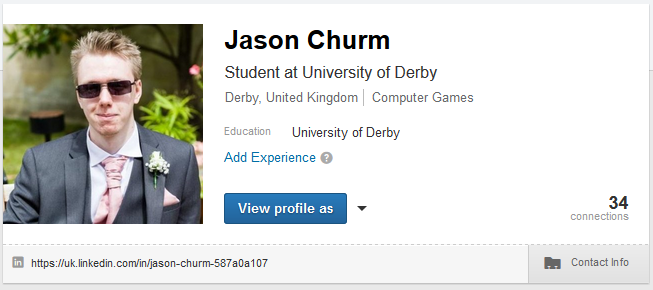
Linked-in, Ive managed to amount 34 connections so far and it’s still building
by the day.
On top of this, I have begun using Twitter to showcase work
as many people on the course have. This should help solidify myself as an
artist as time goes on but more than anything, gets my work out there. I will
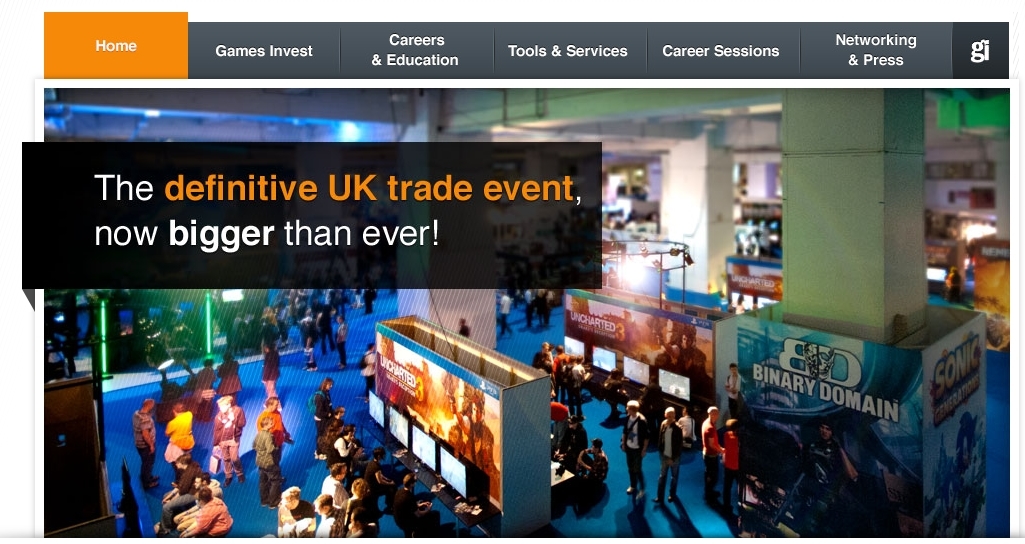
be attending Euro-gamer to attempt to make contacts with as many game
developers as I can and would like this to become an annual event. I can use it
as an ability benchmark, turn the entire event in to an enjoyable progress
point to look back on.
Forums such as PolyCount are essential for feedback but
beyond anything, level and asset design contests are beyond the best form of advertisement
as they not only showcase your ability, many also require a progress blog which
will publicly present your time management skills. A few I have looked in to in
the past are;
^Still going on but they have done multiple of these over
the years.
^Moddb done tons of these contests, even with substantial
awards.
^As a recently released game, it provides a huge amount of
assets to help the design process and also being Unreal Engine, there is a huge
possibility that winners will be displayed on the engine launch screen.
^Allegorithmic are starting to do a tonne of contests and
openly showcase the winners across Twitter, their website and Youtube channel.
With multiple winners each time, if you succeed, they will get your name out
there. As im currently learning their software suites, it’s a fantastic thing
to aim for.
Freelance or Contract staff?
I would personally not want to work freelance in a company,
if I was going to work in-house, I would greatly prefer to be a contract staff
member although this is much easier said than done. There would always be the
change of becoming a permanent staff member through this although it’s a lot
more financially feasible for a studio to take on contractors during busy
periods as they are expendable.
What would be best for me?
In regards to long term goals, I would probably at this
stage like to start as a junior artist, get some experience and a title under
my belt before stepping towards other companies if possible. I wouldn’t very
much enjoy moving to a large company as it seems like a much colder experience
from what I have heard from multiple ex-university students and industry personnel.
If I could, I would prefer to work in a mid-sized company such as Sumo Digital.
This would provide a nice balance between job security and work appreciation if
their phenomenal presentation was any indication.
In short terms, I’m starting to shy away from contract work
as the stress created due to the lack of job security greatly outweighs the pay
increase in my opinion. Ability wise, I have a few areas of texturing that I wish
to further develop and need to take a short course in Z-brush. This would be
easiest done via 3D tutors as I Haven’t spent long enough in the software to
create a nice foundation for experimentation and could benefit greatly by
having it displayed on my CV.
In all honestly, I will need to find a part time or
hopefully full-time job after graduation for a minimum of 6 months if I cannot
find game industry employment within the first few months. With some money then
stocked up, I would like to enquire about work experience at Sumo Digital for
at least a three month period. If there is a possibility of a paid position
from this, I will follow it. Otherwise I will simply use it as a reference for
my CV. I would like to repeat this process at a second company if possible if I
have the finances available but with two large names on my CV, I can see it
helping greatly when it comes to permanent employment.
CV and Cover Letter – How to Improve
For the week 9 presentation, we were given another talk on
employability, this time focusing entirely on the CV and Cover letter whilst
the last talk focused of generally getting us out there and finding the job
market.
Straight off the bat, we were told that young applicants
lacks greatly in both the skills and experience to find employment in their
work sectors. Experience would pose the greatest problem as it’s required to
get almost any job as a 3D artist but at the same, time no one is willing to
give you the opportunity. Of course I could attempt to contact a game company close
to home in the Derbyshire area and ask for work experience but this would be a
huge financial drain and would force me to live with my parents until my
experience had built up enough to find paid employment.
On the other hand, I could attempt to find a part time job,
attempting to take low-paying freelance work (we’ll get on to this in detail
later on) or even join a dedicated modding team. With engines such as Unreal
Engine 4 being free to publish on and already owning legitimate copies of my
software packages, there would be direct financial risk here. I could even pursue
modelling/ map making contests in hopes of gaining experience, making
connections and the possibility of attracting future employers as I have
mentioned before but let us get back on topic.
Lets start with the top 10 skill shortages amongst
graduates;
Commercial Awareness – 67%
Basically, do you know the company you’re applying for, are
you aware of what would be expected of you, what would you would be given and
the general business side of the company you wish to work. How did you put
yourself out there? How do you make yourself a favourable candidate. With some
individuals, commercial awareness becomes second nature, especially with the
more curious people but others simply wish to develop their skillset, become
good artists and sit at a desk, completing their day to day task. How are you
going to show yourself off to the employer?
Communication Skills – 64%
It may seem quite self-explanatory at first but do you truly
know how to put your ideas and opinions forward in a way that is easily understood
by all those in the room? Communication skills are the backbone of all
leadership, team work and social activities. The better people can get along
with you, the easier it would be to make friends and even break the ice in
interviews. If you suffer from anxiousness or are very easily feel the effects
of stress, this may be an incredibly awkward point to get past but I personally
found video recording and editing to be a great way to build self-confidence.
Without self-confidence, even the best employee could trip up before they get
their opportunity to shine.
Leadership – 33%
This is quite an awkward one as it simply involves proving
you are a personal capable of leading a team. This experience could be anything
from a part time job from your past that gave you an authority position, a
breakdown of events where you successfully took charge in a mature and
constructive fashion or even evidence of team building exercises from your
youth. For many, attending cadets gave them this experience very early in life
and if you do not currently have team building experience, it’s important to
gain this before the course has finished.
Ability to work in a team – 33%
This one is quite self-explanatory. How well do you work
with other people? Very reliant on your social skills, can you get past any
personal feelings in a worktime environment for the benefit of the project? Can
you be polite, courteous, share your skills and take any action that would help
improve the team, involving even time management? It’s a small world in the
game industry, so try to make friends otherwise it could come back at you when
you begin to seek employment.
Problem Solving – 32%
Do you have the ability to solve problems? Personally I find
it quite enjoyable and do not like to back away from a challenge. This is the
same reason I hate taking the easy way out if I wish to accomplish something
but don’t posses the ability. As we’re still in a learning environment, if I
cannot get something to work, I’ll find documentation, tutorials or generally
keep trying until the issue is fixed. It may seem like a waste in some people’s
eyes but every small victory adds up, permanently improving your workflow for
the future. I can see many people avoiding this mentality as it is highly
stressful and impossible to create time estimates especially when the problem
could simply be down to the software itself.
Conceptual ability – 21%
Can you think creatively about a problem or even just think
outside the box to find an obvious solution. Can you look at a piece of work or
abstract idea and create an understanding of it or even develop these creative
ideas yourself. Practically, can you open your mind to new ideas and learn from
them to benefit the workplace/ your job placement/ the company as a whole.
Subject Knowledge & Competence – 19%
Can you understand the work given to you, the subject matter
and work independently if required? This is incredibly important for any job
otherwise many man hours would be spent simply child-minding. Of course if it’s
a new job, you will require guidance but it will hit a stage where not only
will you be left to work yourself, you may then be put in charge of other
employees. Having adequate subject knowledge and competence either way will be
built with time but a strong foundation should be present, especially in
something as demanding as the games industry.
Foreign languages – 12%
With only 12% of applicants having foreign language skills,
its an incredibly lacking point. Everyone will have studied foreign language at
GCSE but very few actually continue onwards with it. It may seem useless when
applying to join the game industry but bear in mind that many larger companies
are not just based in America and England, many game companies branch out to
areas such as India, Germany, and France etc… It’s an impossible task to learn
a second language alongside university but it’s a good point to bear in mind
for the future.
Numeracy – 19%
How are you basic mathematics? We’re not looking to go in to
industry as programmers where this would really shine but when working with
game engines, having basic maths skills could help save a lot of time in
anything from asset management to UI. For all we know, we could join a game
company and be provided with an in-house engine that relies on command lines.
Even something as simple as ensuring props are scaled properly across a level
would be much faster if you could perform basic equations in your mind whilst
working.
Good General Education – 15%
Of course your education is important for any job
application so having good GCSE’s and A levels/ College degrees can benefit you
greatly in the long run although when applying for an artist roll for the game
industry, will they be just as important? They can be a good indicator for the
individuals work ability but when our employability is based almost solely on
the skills showcased on our portfolios/ showreels, it makes past qualifications
seem a little useless.
With all these key areas covered, what have we learnt so
far?
-Without covering the same area twice-
From Real Time Environment Development;
-Modularity
-Time management
-Communicating Ideas
-Presentation Skills
-Industry Workflow
-Independent Work
3D Rigging Systems;
-Ability to learn new software techniques
-Minor Programming
-Competence
-How to prep work for an animator
3D Digital Sculpture
-Mature working attitude
-New software suites
-Basics of anatomy
-Zbrush based workflow
Specialist 3D Project
-Ability to plan
-Work entirely independent
-Plan and showcase ideas
-Respond to feedback/ criticism
-Creativity
Applied Game Art Production
-Team building
- Leadership skills
-Group time management
3D Animation for Games
-Team leadership
-Inter-personnel training
With all these areas covered, we were told that 87% of
companies have at least 1 unfilled graduate roll, 67% of applications have been
of “insufficient quality” and warned to avoid overwhelming our CVs with content
as it could put off possible future employers. The next step covered were the different
types of CV; starting with chronological, the CV format orders achievements
chronologically which is still desired for almost every roll although it
provides very little to no room for creativity which could make your CV stand out
from other applicants. Above all else, do not put “references can be supplied
on demand” as this is seen on almost every CV. Personally, I have to do this as
I don’t currently have too wide a range of references available.
An alternative would be to format it as a “contemporary” cv,
ordering achievements according to skills instead of date, providing a little
more reference for the interviewer which could make a world of difference and
give you much more creative freedom as well as allowing you to organise the CV
based on the job role. For an internship/ placement or graduate roll, this
could be perfect. My current CV format follows the Chronological pattern so
this will need to be edited before I can start applying for any game related
job position.
The Housekeeping/ rough boundaries to follow;
-No more than 2 sides of A4 (less is more
-Do not include pictures
-Ensure your contact details are readily available
-Use a professional font
-A font size between 10-12 seem to work the best
-Keep all language and vocabulary professional.
-Avoid large blocks of text as it can be hard to read.
-Bullet points are key
-Put your best possible points straight up first, sell
yourself.
For the skills section, look at what is most relevant for
the roll and list these with examples. For example, the huge list of skills we
learnt across the past two years. These are invaluable and have been drilled in
enough that we have plenty of justified examples of each.
Last of all, we should be writing a cover letter for each
job applied for. Make sure a lot of research is done in to the company first,
what they would be looking for and try to sell them what they want with a candidate.
At this stage, a bit of self-confidence and a lot of research in to the job
roll could go a long way.
Subscribe to:
Posts (Atom)